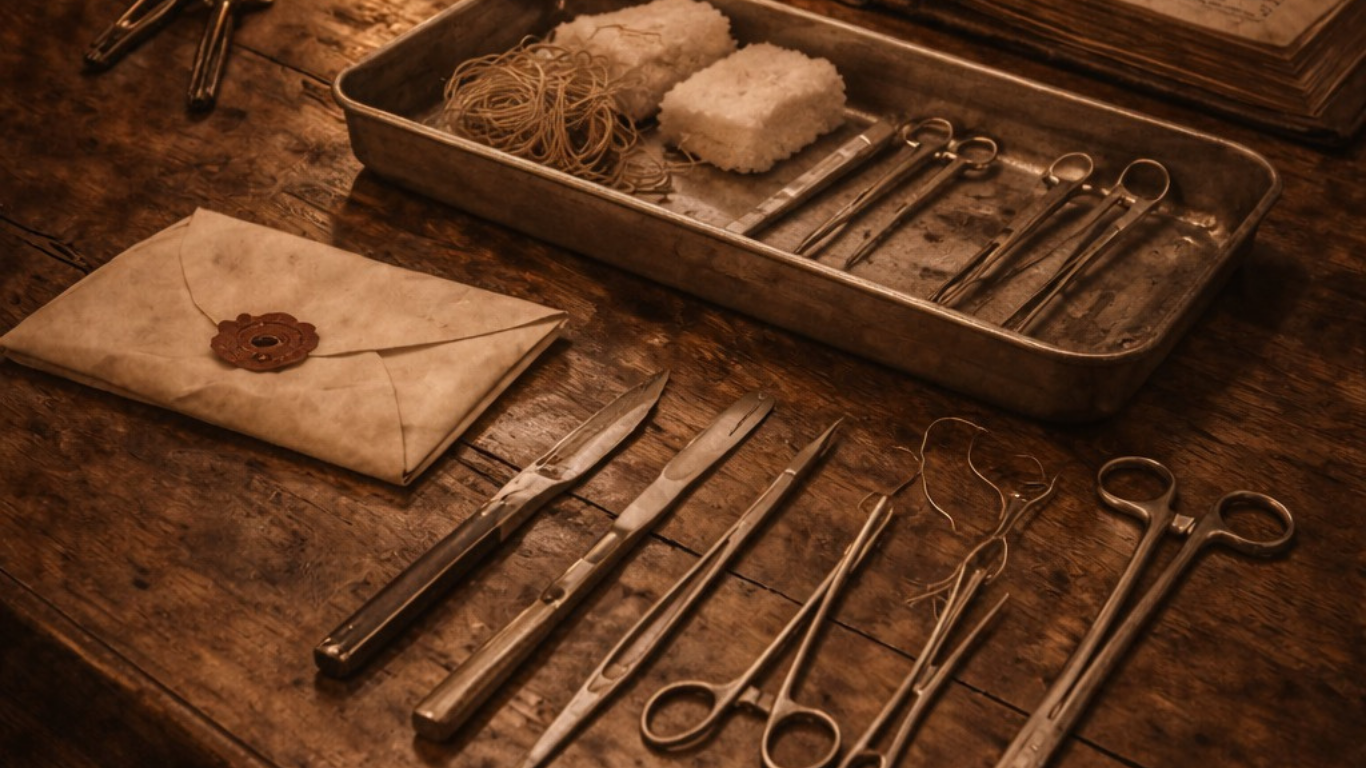
In the 19th century, a midlife woman with what we’d now recognize as perimenopausal or menopausal symptoms could be treated as if her body were a runaway system in need of urgent mechanical correction. If bleeding became unpredictable, pain relentless, sleep impossible, or mood symptoms alarming, some clinicians did not frame it as a life stage to be supported. They framed it as pathology to be stopped.
And one of the most consequential ideas that took hold was this: induce “the change of life” on purpose by removing the ovaries.
This post focuses on that moment in medical history, not to sensationalize it, but to make it legible: why it happened, who it harmed, what it reveals about power and consent, and what it still teaches us about women’s health narratives today.
What “fixing it” meant: removing healthy ovaries to force menopause
On August 17, 1872, physician Robert Battey performed what he described as the first “normal ovariotomy”: removing both ovaries even when there was no obvious ovarian disease, with the intention of shutting down ovarian function and driving an early menopause.
That detail matters. This wasn’t the removal of a tumor. It was an operation built on an idea: that ovarian function was the driver of certain “female” disorders, and that stopping ovarian function could stop the disorder.
In Battey’s own framing, the logic was blunt: if the surgery didn’t produce the “change of life,” it failed in its entire purpose. In his 1873 paper, he tells his audience that if he hasn’t achieved that, then he has “done nothing—worse than nothing.”
It’s easy to read this history and wonder: how did this become thinkable?
A few realities converged:
1) Women were often suffering without reliable relief
Some patients had years of pelvic pain, severe bleeding, seizures described in the medical language of the time, or disabling symptoms clustered around menses. Battey’s first “normal ovariotomy” case (as later summarized) involved a woman described as having long-term suffering and repeated failed treatments before surgery was proposed.
Whether or not the diagnoses would hold up today, the desperation was real. When you’re exhausted, bleeding, in pain, and afraid, “radical” can start to sound like “finally.”
2) The ovary was becoming a symbol, not just an organ
The 1800s medical imagination often treated the reproductive organs as command centers for women’s physical and mental stability. Removing ovaries could be pitched as removing the “source” of storms: nervous symptoms, convulsions, irritability, “madness,” sexual desire considered excessive, and other behaviors that troubled families and institutions.
3) Surgery was gaining status fast, even when risk stayed high
Abdominal surgery was evolving, but the danger of infection and postoperative complications remained significant. Even proponents acknowledged serious tradeoffs. Battey’s own paper lists the feared consequences surgeons believed could follow ovary removal: infertility, loss of sexual sensation, and even masculinizing changes like facial hair growth.
This wasn’t subtle. It was an era willing to consider “unmaking” a woman’s reproductive capacity and parts of her identity in exchange for symptom control.
What the operation actually did to women’s lives
The American College of Surgeons’ historical overview states plainly that removing both ovaries drove women into early menopause and infertility.
That means the “treatment” for distress could create a new set of lifelong consequences: hot flashes, mood changes, bone loss risk (not understood then as we understand it now), sexual changes, and the social reality of being permanently infertile in a time when fertility was often tied to a woman’s value and security.
And while the medical literature might treat that as a clinical outcome, women lived it as a social outcome.
The part history won’t let us ignore: consent and coercion
Even if some women actively sought the procedure, not all women had the power to refuse it.
The ACS overview notes that for women institutionalized with “hysteria,” the operation was likely performed without their consent.
That one line contains an entire world: the asylum, the husband or guardian as decision-maker, the physician as authority, the patient reframed as unreliable, and the body treated as a site where social order could be enforced.
This is the uncomfortable hinge; the operation wasn’t only medical. It was also cultural control, routed through medicine.
When a procedure becomes a “fashion”
Once an operation exists, it can spread beyond its original rationale.
A chapter on the history of surgical innovation describes how the procedure’s naming and branding mattered, how it traveled, and how debate intensified as deaths and complications became harder to minimize. The same source notes that by the 1880s, the mortality rate for the new operation was a flashpoint, and cites surgeon Robert Lawson Tait’s reported mortality figures in 1883, with improvement by 1888 in his practice.
It also records the backlash language that emerged: critics warned of women being “unsexed,” and ovarian surgery was increasingly described as a “fashion.”
That framing is revealing. When something becomes a “fashion,” it suggests momentum that outpaces evidence, and a clinical culture that can confuse novelty with necessity.
The parallel cautionary tale: surgery to “fix” behavior
To understand the mindset of the era, it helps to hold Battey’s operation next to another notorious Victorian controversy: Isaac Baker Brown, who promoted clitoridectomy as a “solution” for epilepsy, hysteria, and other “nervous diseases,” tied to beliefs about masturbation and “peripheral irritation.” A detailed historical analysis notes Brown’s rise, the professional reaction, and his expulsion from the Obstetrical Society in 1867.
These are not identical cases, but they rhyme:
- Women’s distress was frequently filtered through moral assumptions.
- Surgical intervention was offered not just for disease, but for acceptable womanhood.
- Consent was not reliably protected, especially for the vulnerable.
What this history still teaches us
It’s tempting to treat this part of history as a museum exhibit: shocking, distant, resolved.
But it carries modern relevance in quieter ways.
1) It warns us about single-cause stories
When a complex human experience is reduced to a single “problem organ” or a single “root cause,” drastic solutions become easier to justify.
2) It shows why informed consent is not just paperwork
Consent is not a signature. It’s the lived reality of whether someone is free to say no, free from coercion, and given alternatives that are actually accessible. The historical record shows how quickly “treatment” can become something done to women rather than with them.
3) It invites a better question than “What’s the fix?”
A more humane question is: What support, options, and dignity does a woman have while her body changes?
The women in these stories weren’t abstractions. They were people navigating pain, fear, and social vulnerability in a system that often interpreted their suffering as inconvenience, instability, or moral failure.
This is one of the clearest places where menopause history exposes the friction between medicine and culture. A midlife woman’s symptoms could be treated as a biological emergency, a psychological problem, or a threat to social order, and the “solution” could be irreversible surgery.
The point is not to argue that every physician acted with cruelty, or that every surgery was forced. The point is to see how easily women’s distress becomes a canvas for other people’s certainty.
And once you see that, it becomes harder to accept shallow narratives about menopause today, whether they come dressed as shame, silence, or “miracle fixes.”